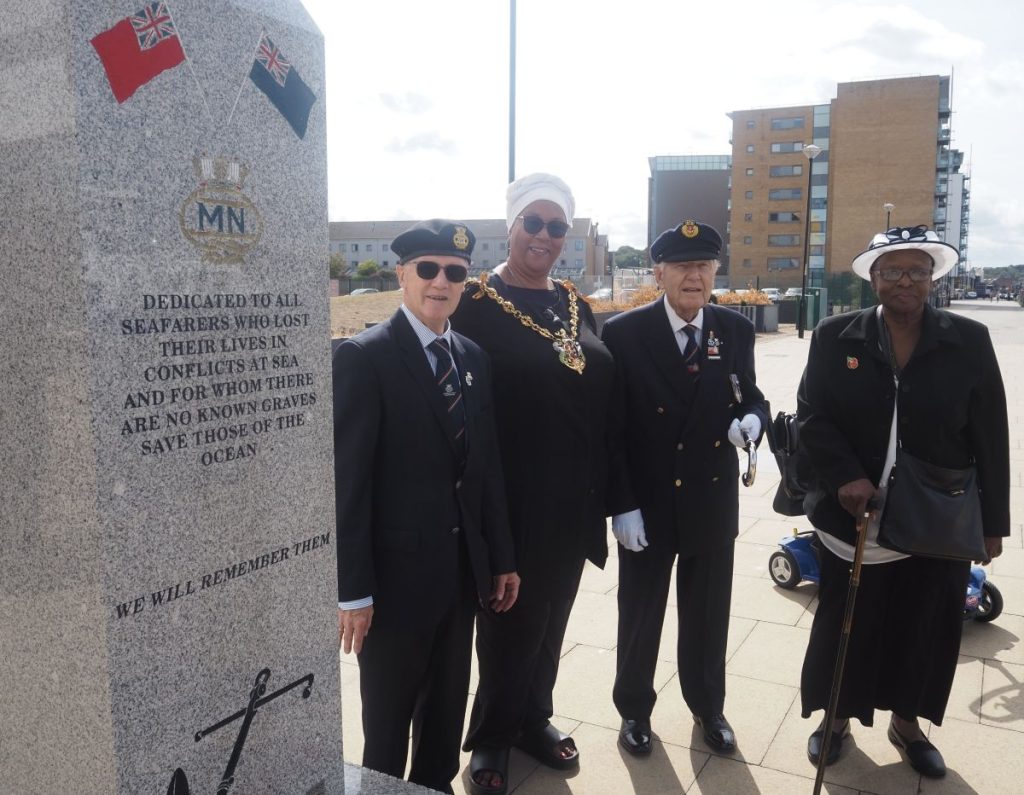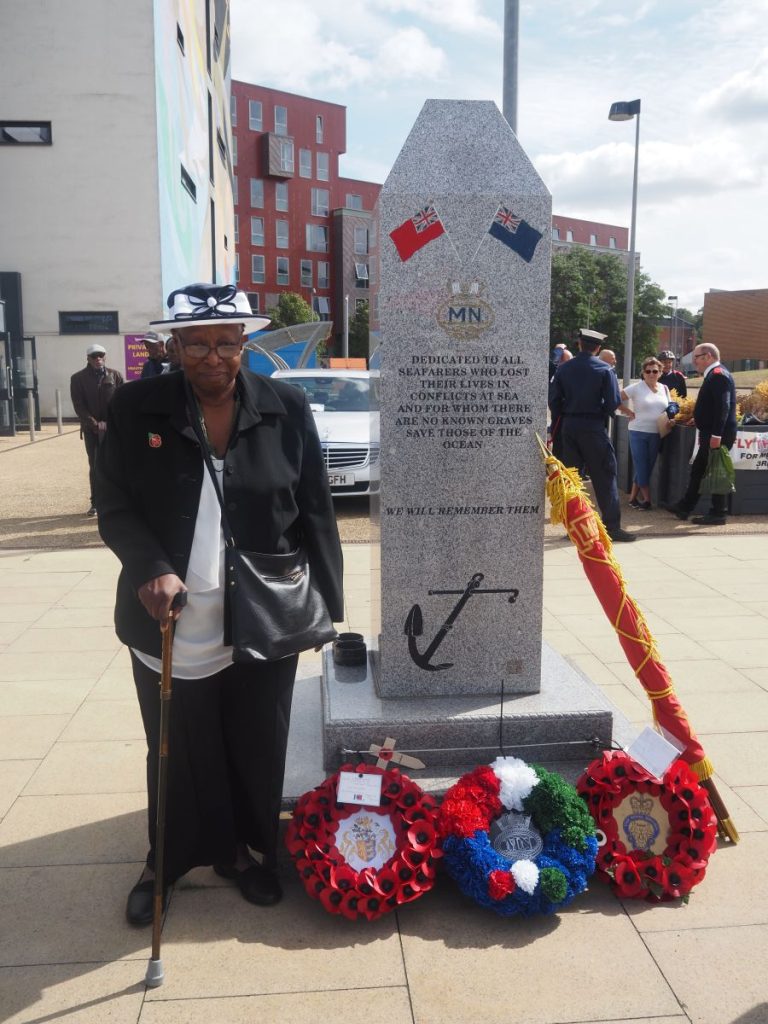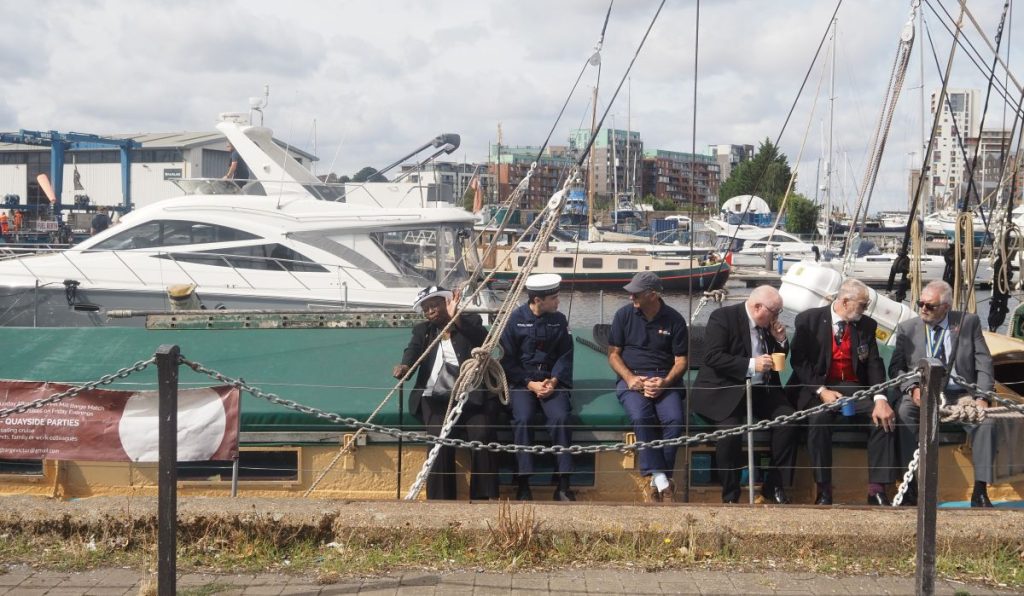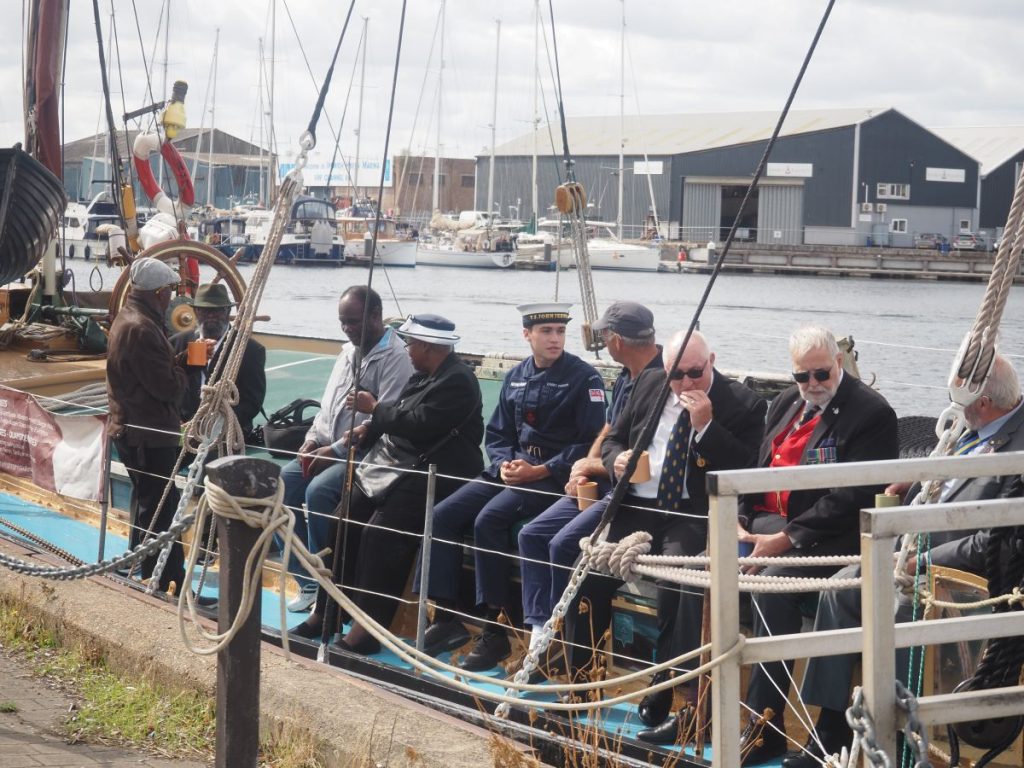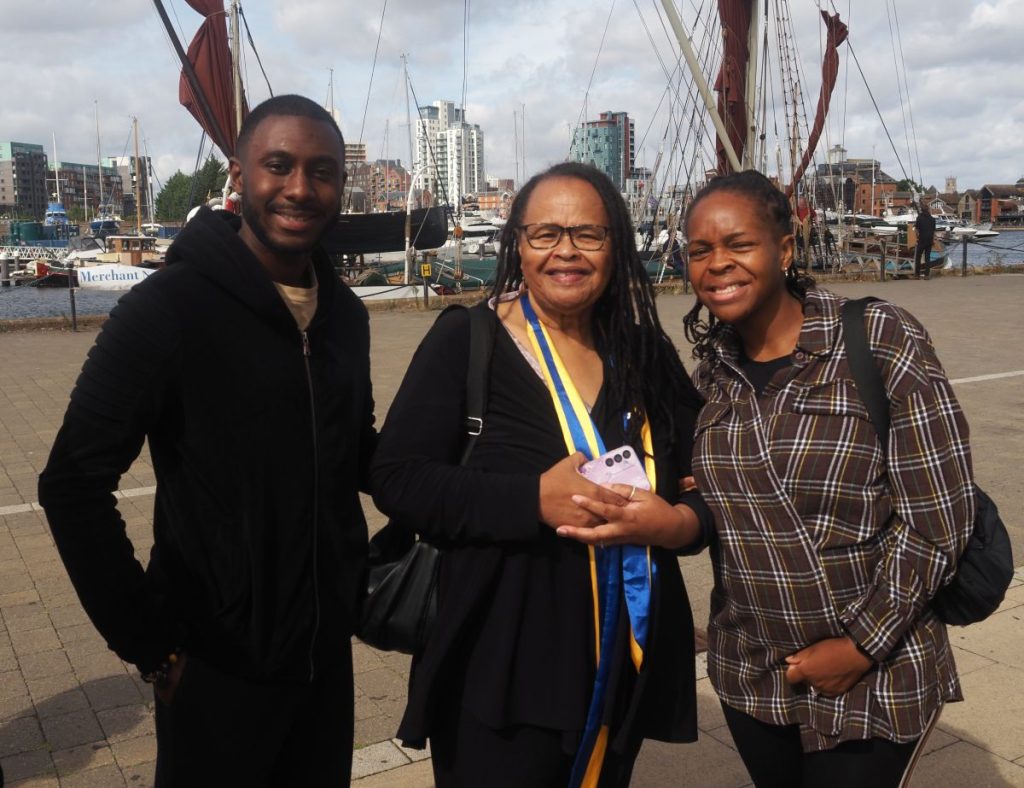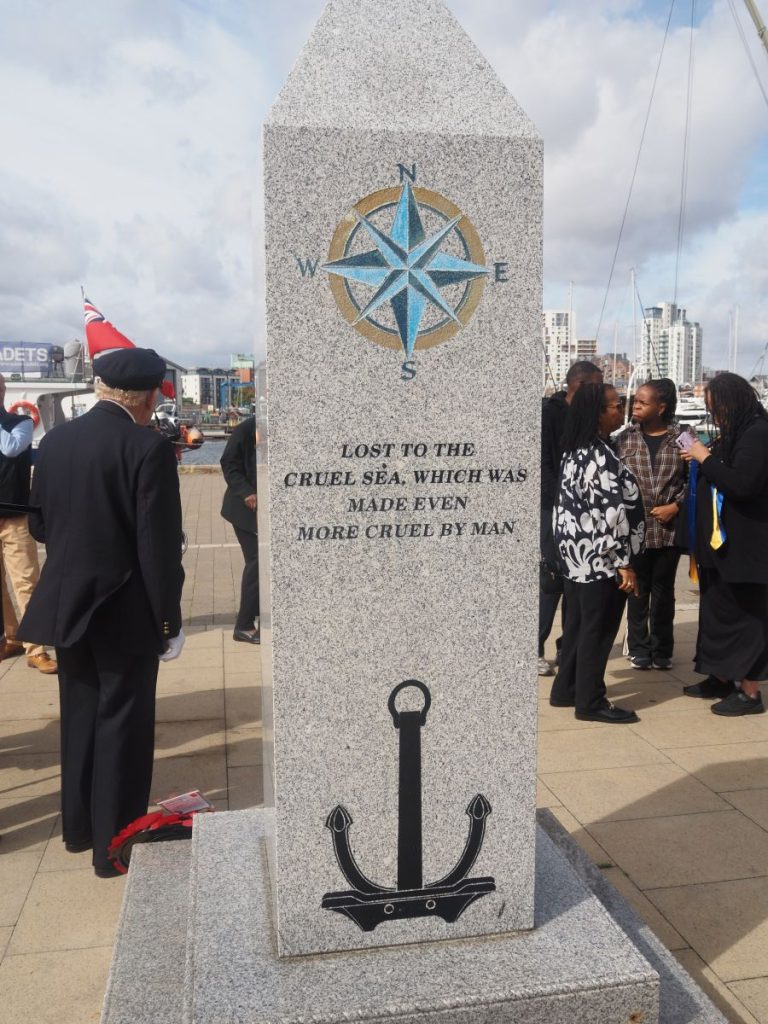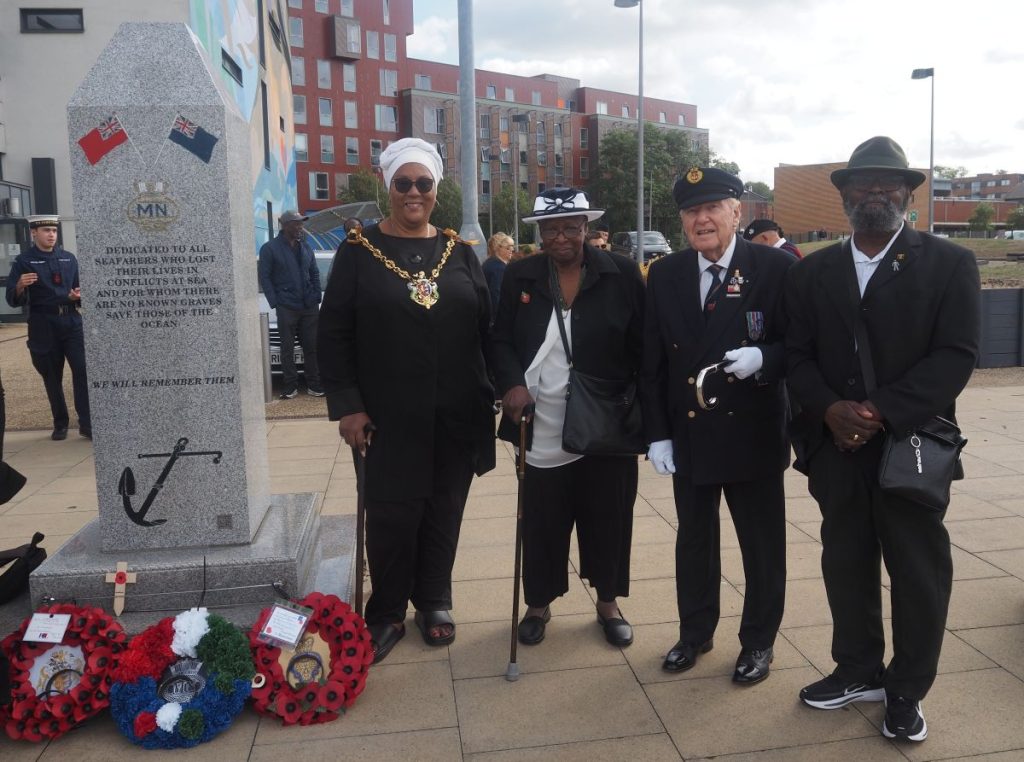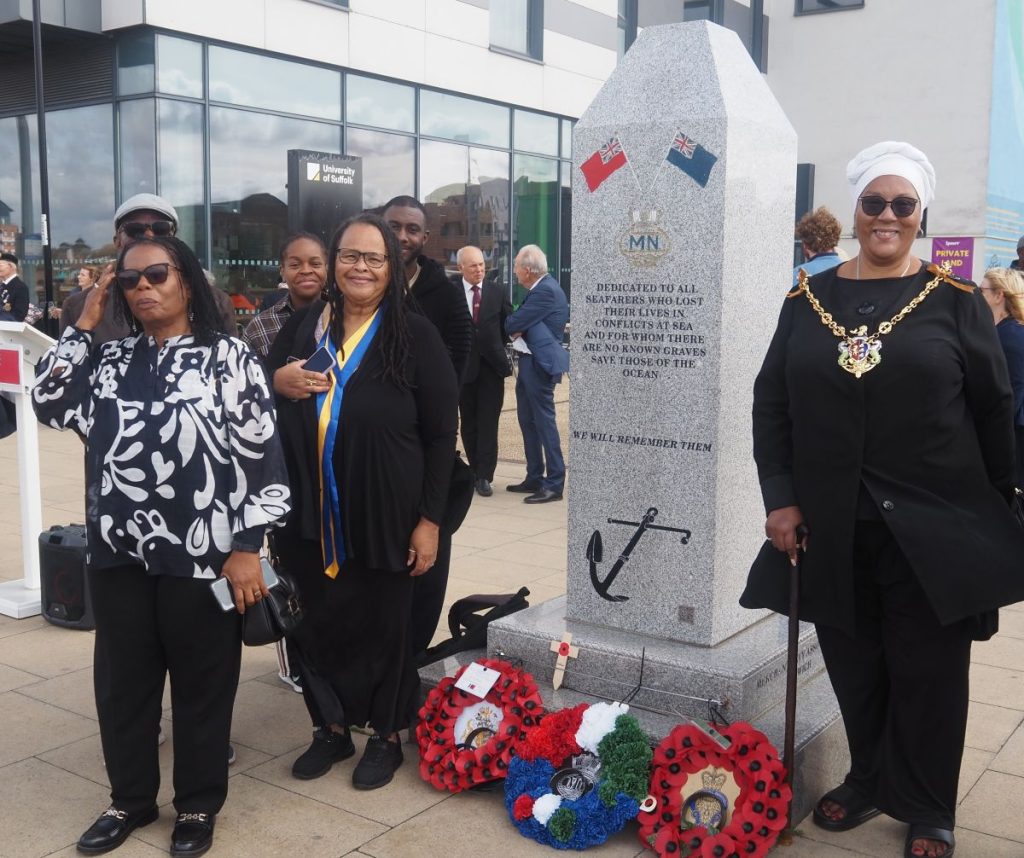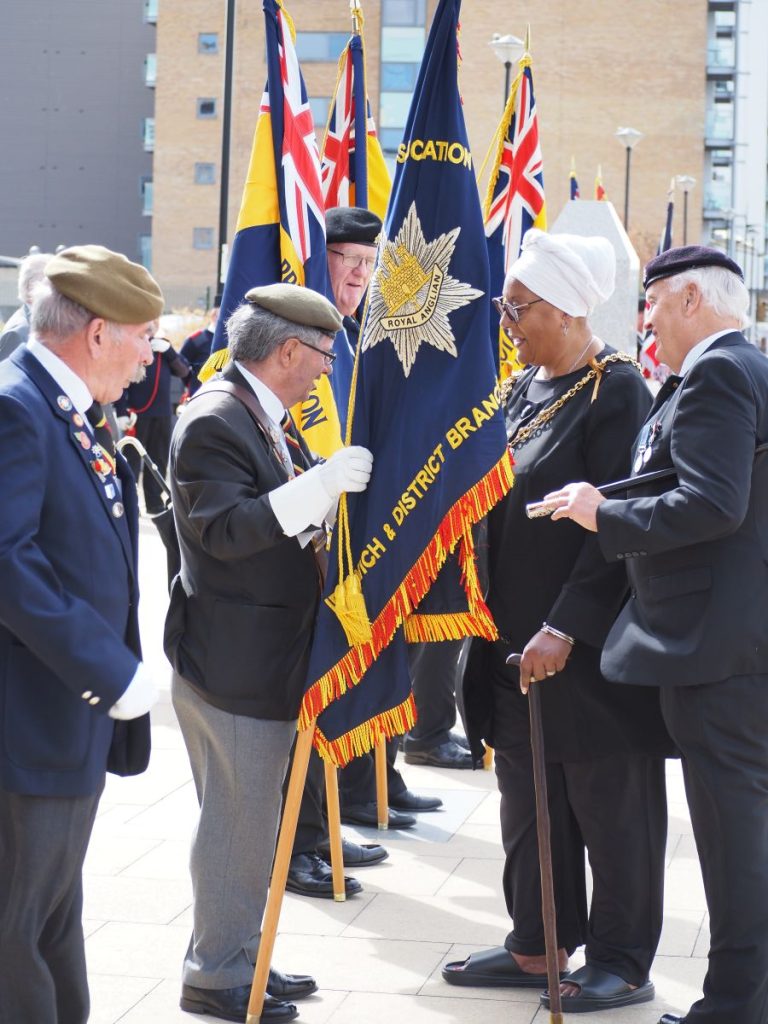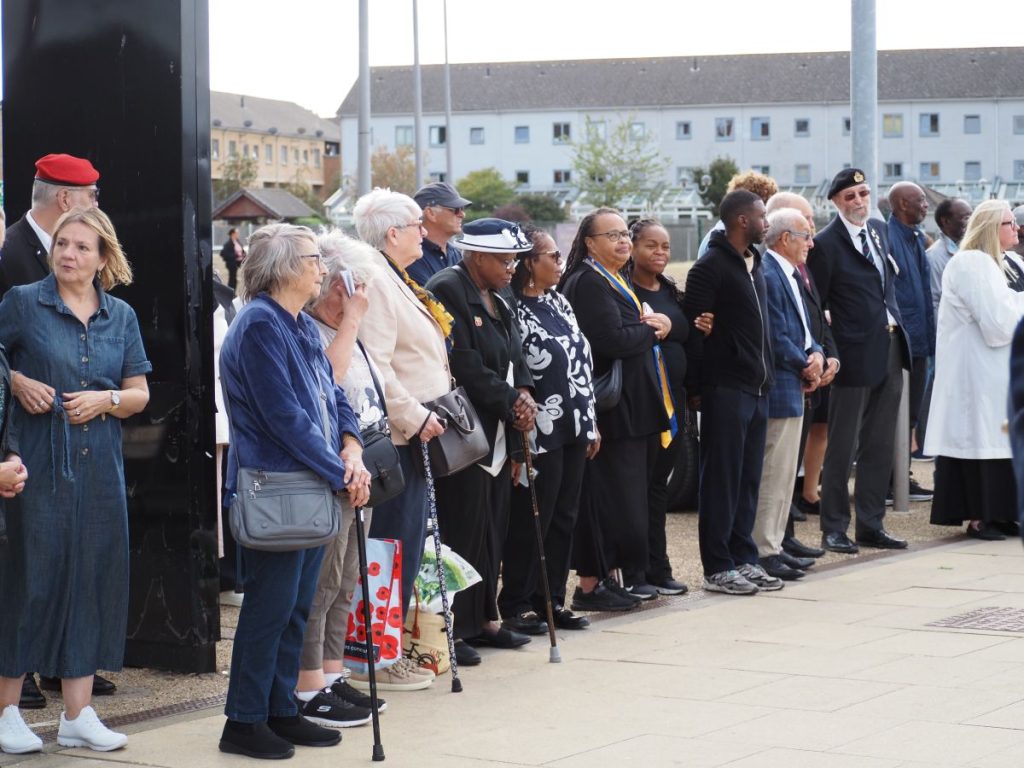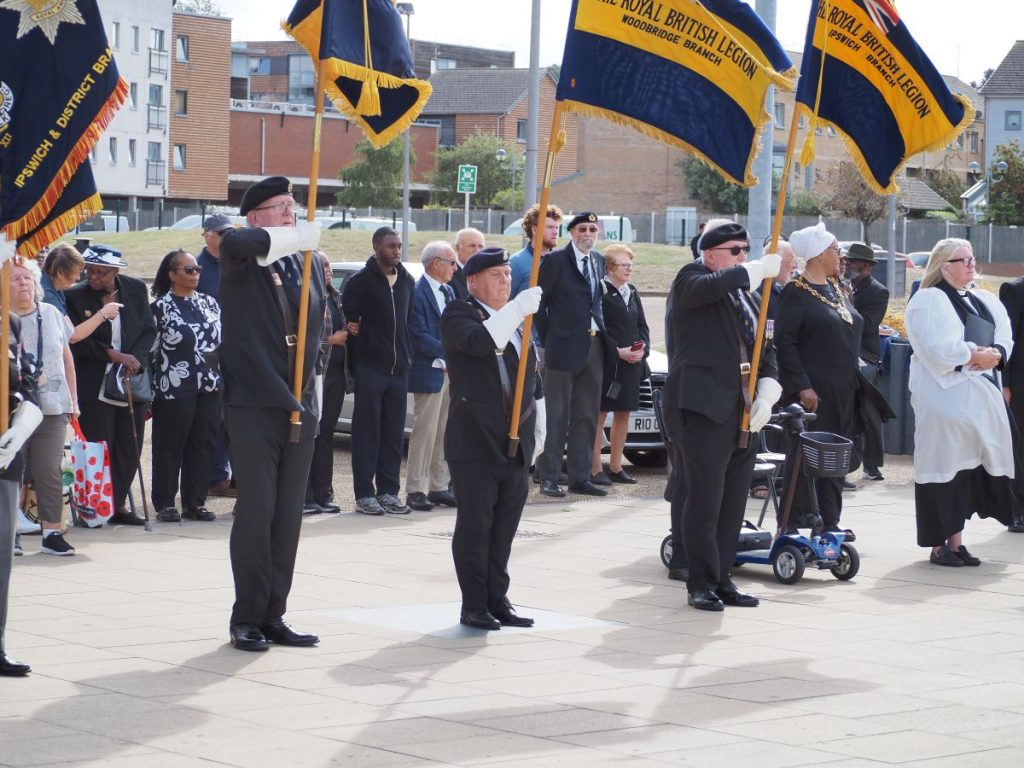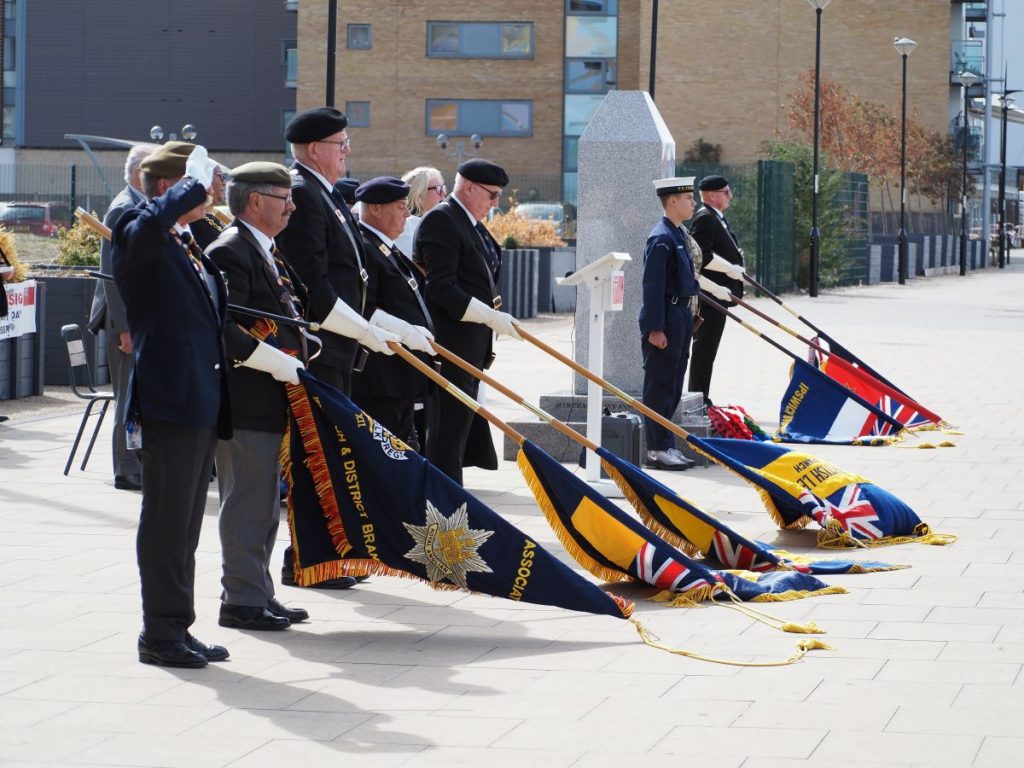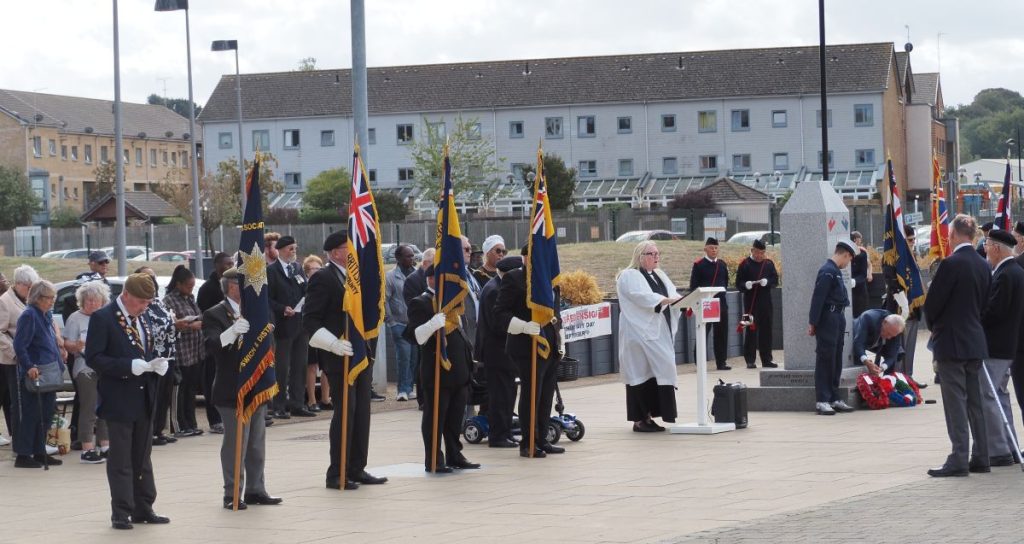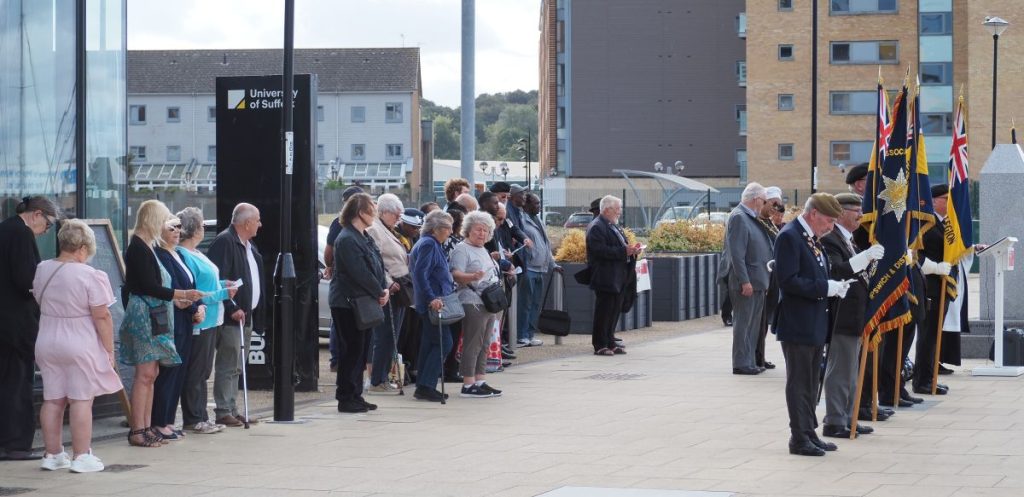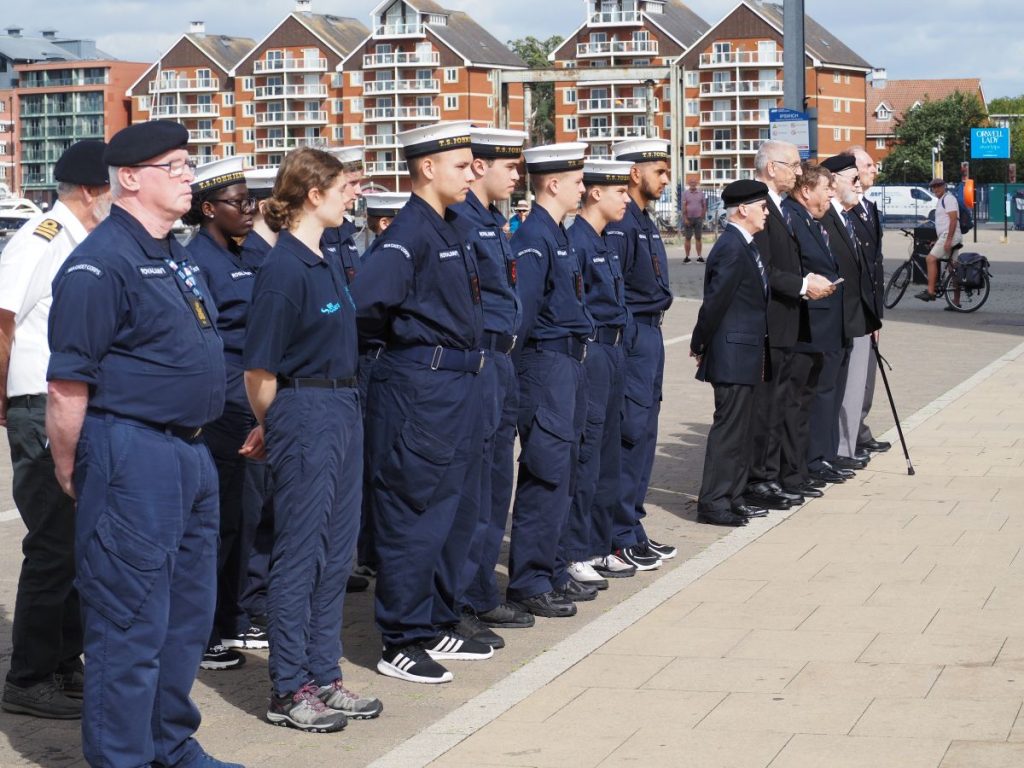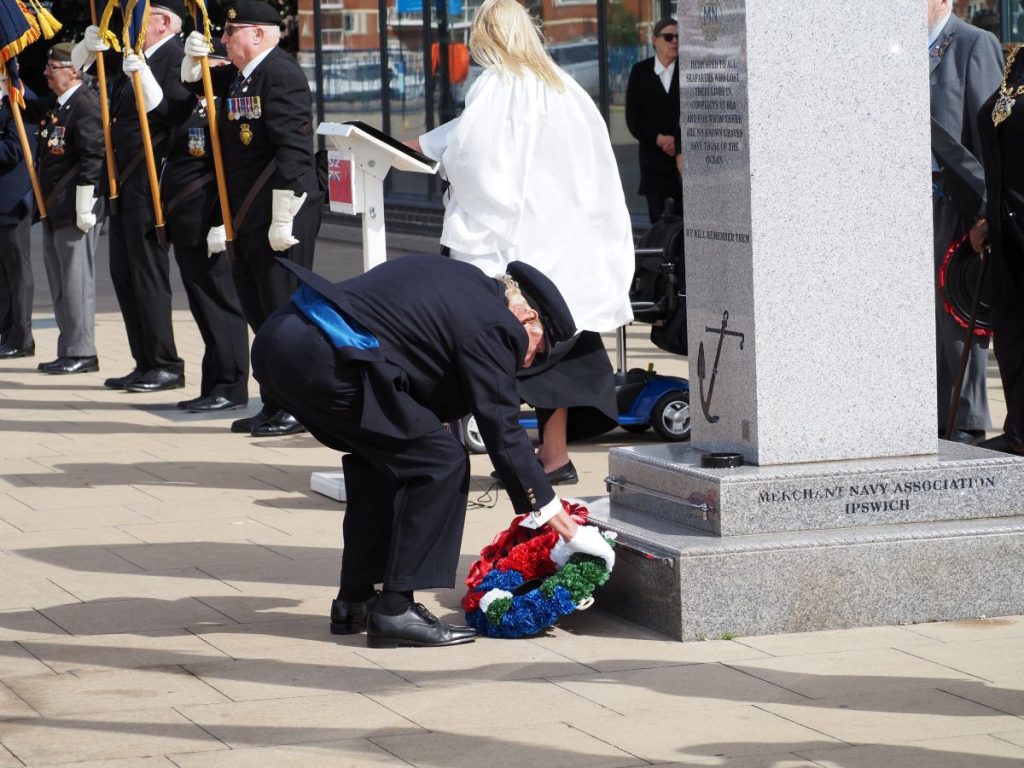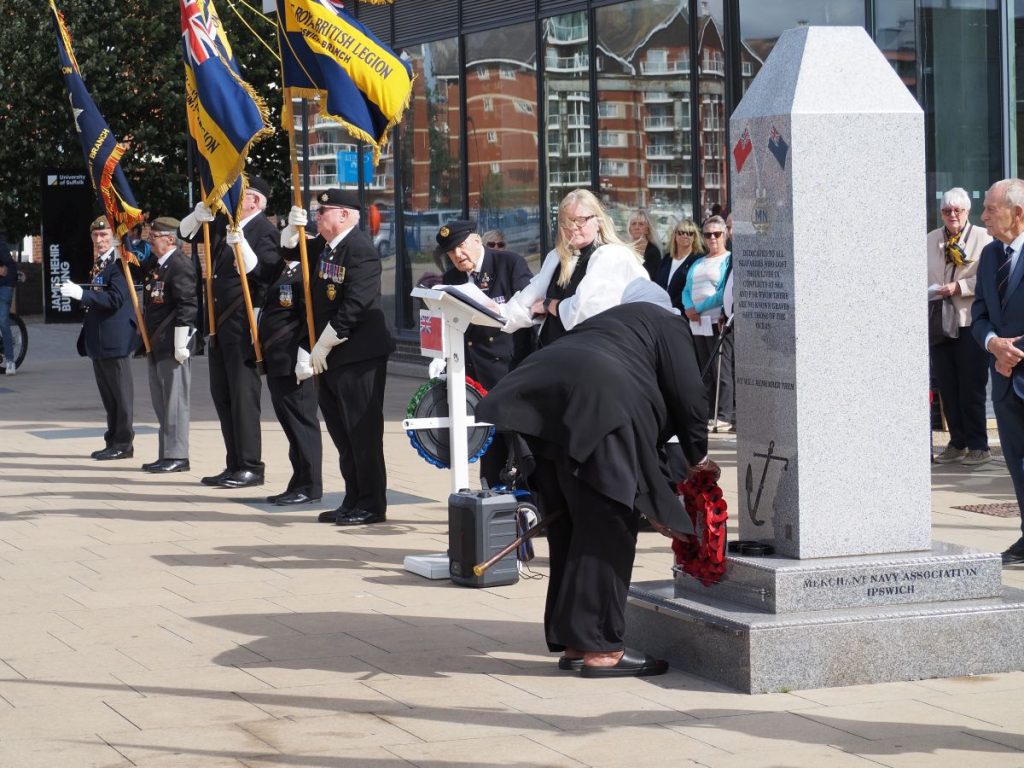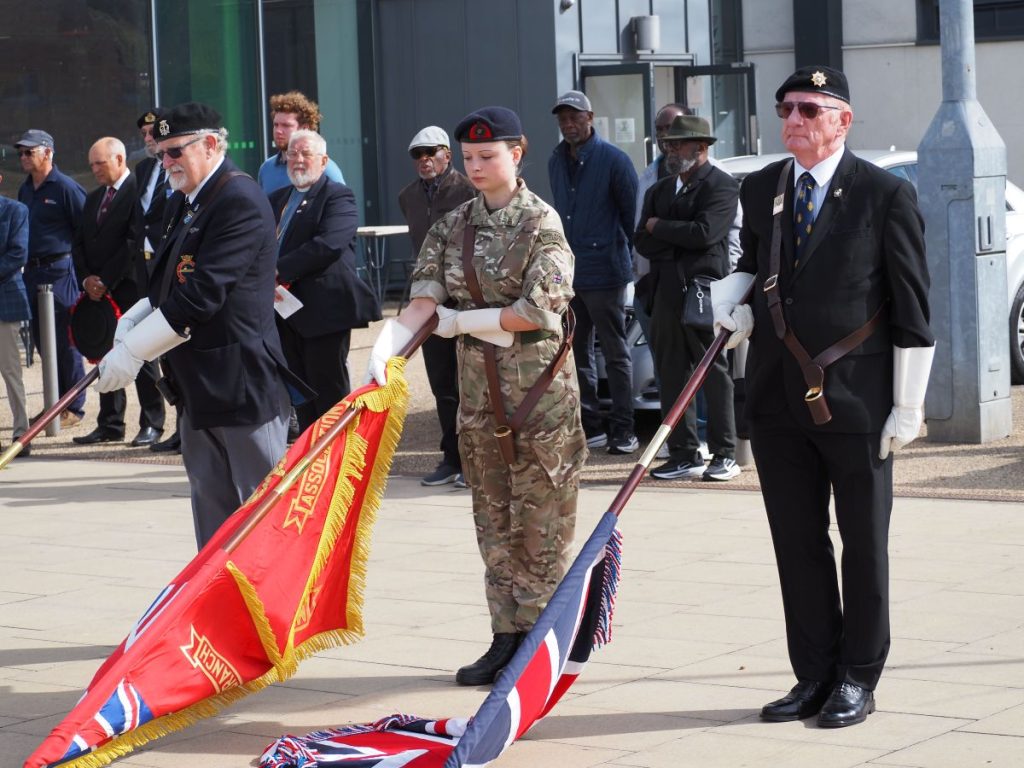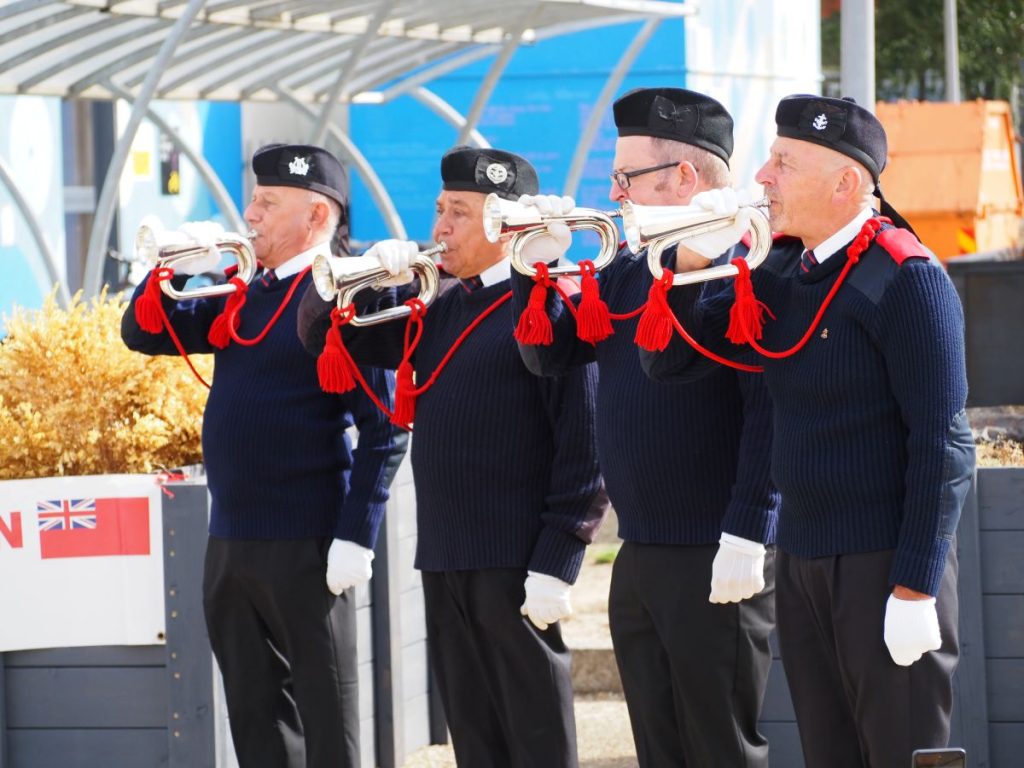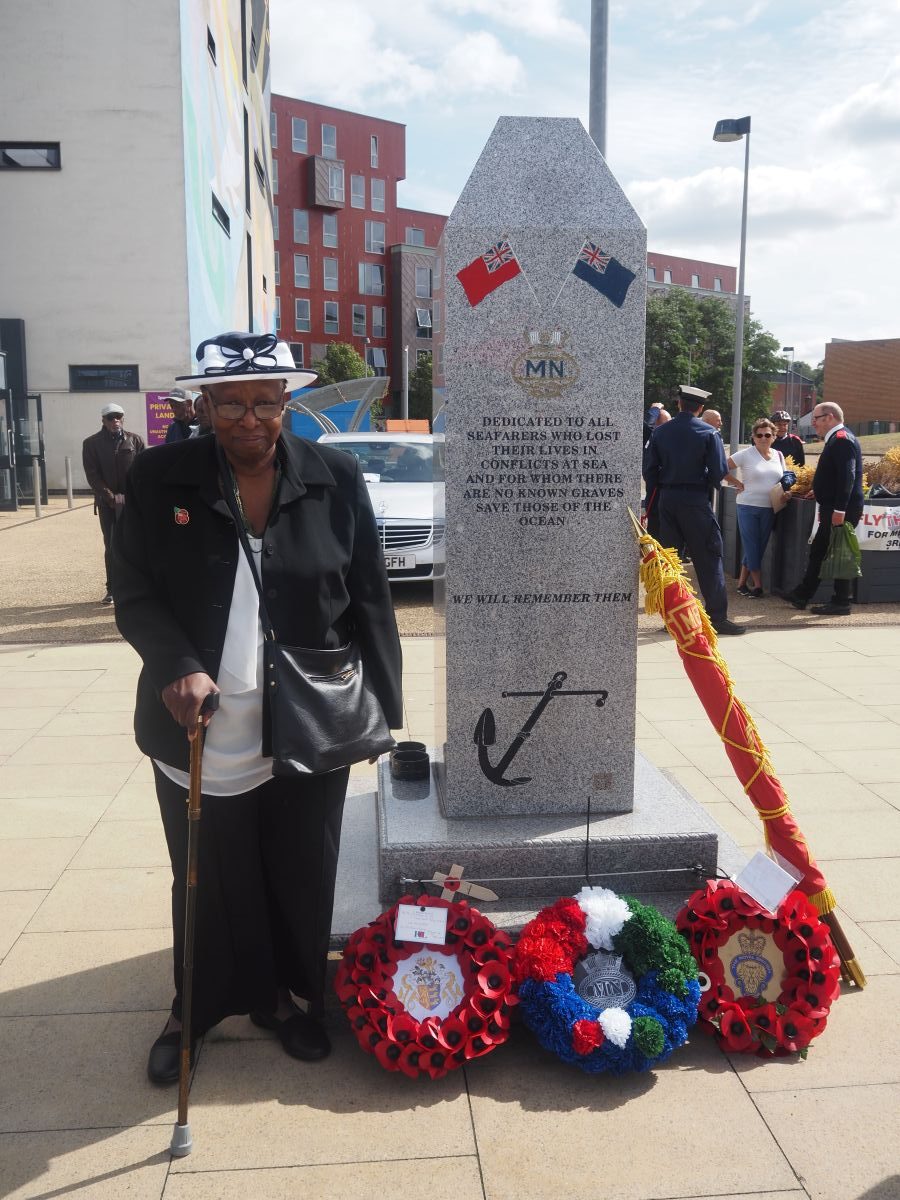
On Merchant Navy Day, 3 September, the Red Ensign rises across the United Kingdom in honour of the 46,000 seafarers who died keeping Britain supplied during the world wars. At Orwell Quay in Ipswich, Suffolk, the Red Ensign carried a deeper meaning. For those gathered- former seamen, families, colleagues, and officials of the Merchant Navy Association, it marked a long-overlooked chapter of maritime history.
At the centre of today’s ceremony stood Sandra Smith, a UK-based Barbadian whose grandfather was among the Bajan seamen killed when the SS Traveller was torpedoed in January 1942. For Sandra, remembrance is not an annual ritual but a lifelong mission. After the Ipswich event, she hurried to take part in her local village ceremony in Woodbridge. She has become one of the most committed voices preserving the memory of Caribbean mariners, working closely with the Ipswich Branch of the Merchant Navy Association, and laying wreaths at memorials in both Barbados and Britain.
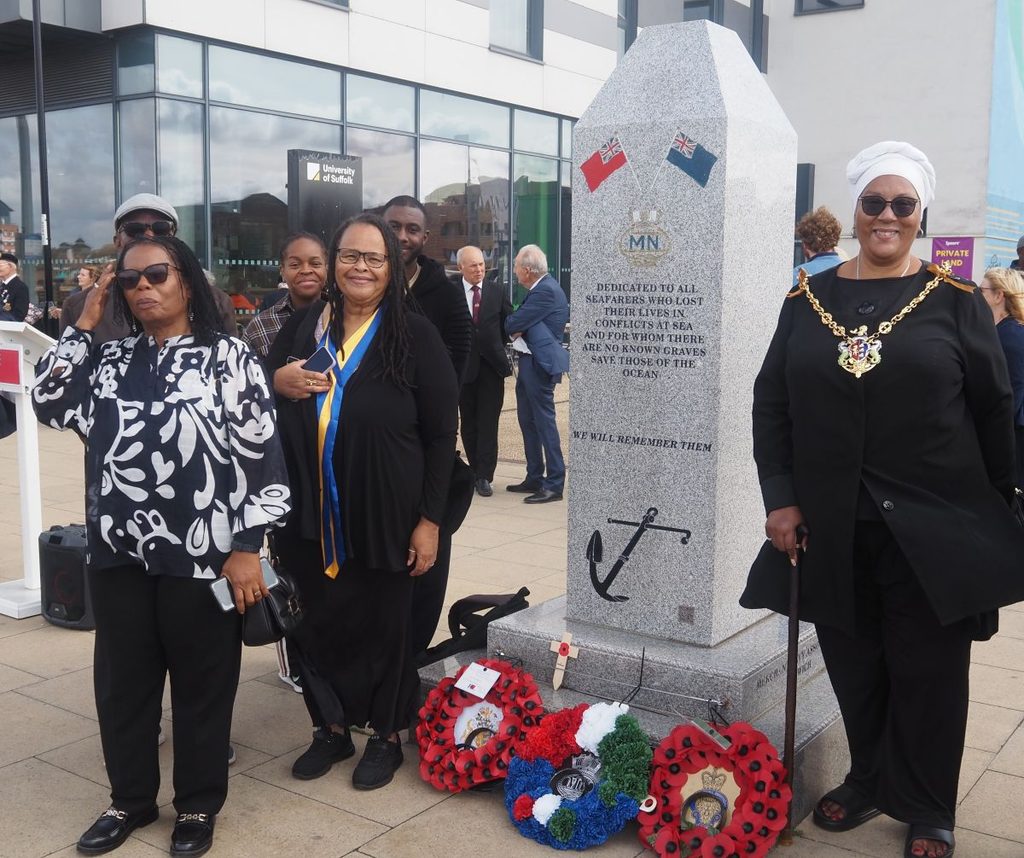
Her commitment has earned support from Barbadian and St Vincentian national community groups in the UK. However, she still struggles to secure diplomatic representation at the London ceremony at Tower Hill. This year, Mr J. M. Brereton Horne, High Commissioner for Saint Vincent and the Grenadines, attended and placed a wreath.
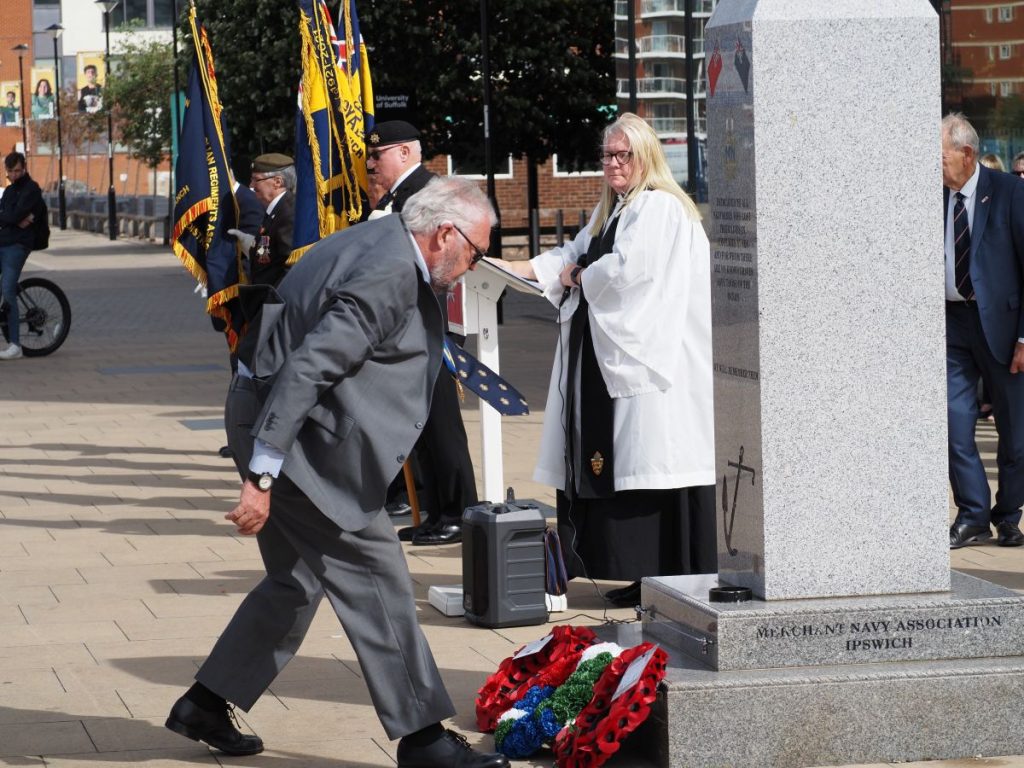
Today, she was joined by relatives of lost seamen and officers of the Merchant Navy Association as they stepped forward to lay a wreath at the Ipswich Merchant Navy Memorial. Beside them stood Ipswich Mayor Pat Bruce-Browne, whose Barbadian and Antiguan heritage made her presence both official and deeply personal. She laid a wreath on behalf of the town, honouring men whose service helped sustain the nation she now serves in public office.
In Barbados, the Barbados Defence Force and the Barbados Cadet Corps host an annual Merchant Marines Memorial Service and Wreath Laying Ceremony at the Barbados Military Cemetery in Gravesend. The service places Barbadian and Caribbean watermen at the centre of remembrance, alongside the families still fighting for their recognition.
During the global conflicts of the 20th century, Great Britain’s survival hung by a thin thread of merchant ships traversing the Atlantic. Facing constant threats from German U-boats, the British Merchant Navy required a tireless supply of skilled, resilient sailors to man its fleets. To meet this demand, the Empire turned heavily to its colonies, establishing a vital recruitment pipeline in Barbados. From that pipeline came hundreds of Barbadian mariners who risked their lives in freezing, torpedo-ravaged waters. This history shows the core truth: Barbadian watermen kept Britain supplied and armed.
Merchant Navy recruitment in Barbados was not a randomised rural draft; it was deeply centralised around the island’s active urban and maritime gateway: the capital city of Bridgetown in the parish of St. Michael. This concentration made Bridgetown the island’s main recruitment hub and the pipeline’s starting point. From that centre, the harbour’s activity drew men into service.
The beating heart of this recruitment pipeline was the Careenage, a narrow, sheltered inner harbour. Here, local trading schooners, regional cargo boats, and massive transatlantic steamships docked side by side. Bajan watermen gathered along the stone wharves to register with mercantile agents, sign on to shipping registries, or be picked up as replacement crew. From there, men entered the pipeline, and the process took shape across the harbour. Nearby coastal communities such as the Bayland and New Orleans fed the same stream of labour.
While Bridgetown was the corporate hiring hub, the men who filled these ships came from coastal communities with deep generational ties to the ocean. Fishing towns such as Oistins on the southern coast and Speightstown, known as “Little Bristol,” in the northwest produced exceptionally skilled mariners. Their mastery of local waters made them prime candidates for the demanding, perilous work of international shipping.
[ BARBADOS RECRUITMENT PIPELINE ]
│
┌───────────────────────────┼───────────────────────────┐
▼ ▼ ▼
[ Oistins ] [ Bridgetown ] [ Speightstown ]
Coastal Fishing Hub The Careenage Port Secondary Shipping Port
(Generational Watermen) (Corporate Registry) (Northwest Seamen)
Major British corporate shipping companies operating out of Bridgetown drove the hiring of Barbadian labour, most notably the Liverpool-based Harrison Line (Thos. & Jas. Harrison), alongside the Royal Mail Steam Packet Company. These employers channelled men from the harbour into imperial shipping work and shaped who was hired and how labour was divided once men came aboard. Their hiring power shows how commercial shipping interests depended on Barbadian labour, and how that labour entered the ships below.
Once aboard, Caribbean recruits faced a sharp racial division of labour. White British sailors held deck positions, while Black colonial sailors were overwhelmingly funnelled into the most gruelling, hazardous environments on the ship: the engine rooms and galleys. This division defined their wartime experience from the start, placing the same men recruited to keep ships running in the most dangerous spaces on board. From there, the danger intensified below deck.
Working as firemen, trimmers, and greasers, Barbadian men spent shifts in suffocating heat, shovelling heavy coal directly into roaring furnaces deep below the waterline. This placement was intentionally exploitative, but during wartime it was also a death sentence. When a German torpedo struck a merchant vessel, it always impacted the engine rooms first. Men working below deck had no warning and scant seconds to escape the rising water and burning oil.
The human cost of this division of labour is embodied in the family history of cricket’s greatest all-rounder and Barbados national hero, the late Sir Garry Sobers. His father, Shamont Sobers, was a Barbadian merchant seaman who answered the call to serve during the Second World War.
On 19 January 1942, Shamont was serving as a general servant aboard the RMS Lady Hawkins, a steam passenger and cargo liner operating within the Canadian Merchant Navy pipeline. While navigating a defensive zigzag course 150 miles off the coast of North Carolina, the unescorted vessel was struck by two torpedoes from the German U-boat U-66.
The ship sank in just 30 minutes. In the darkness, only one lifeboat survived the blast, swamped by seventy-six freezing survivors in a craft certified for sixty-three. To avoid capsizing, those aboard had to pull away from the screams of drowning crewmates. They then drifted for five torturous days on a daily ration of one biscuit, a sip of water, and a spoonful of condensed milk.
Shamont Sobers, just 34 years old, never made it to the boat; he went down with the ship, leaving his body to the sea. Back in Bridgetown, his wife Thelma was left destitute to raise five-year-old Garry and his five siblings alone in an impoverished alleyway. This harrowing, instant financial ruin was the reality for countless Bajan families and shows how maritime law decreed that a sailor’s pay stopped the exact minute their ship sank. His story, in turn, leads into the wider exclusion that followed the war.
Despite these immense sacrifices, Barbadian seamen who survived the First World War returned to institutional discrimination. When the economic slumps of the 1920s and 1930s hit the maritime industry, white-dominated trade unions in UK ports enforced a strict Colour Bar, pressuring shipping companies to fire Black sailors in favour of white crews. Wartime necessity gave way to peacetime exclusion, which was then reinforced in law.
The British Home Office codified this prejudice through the Special Restriction (Coloured Alien Seamen) Order of 1925. This law targeted non-white sailors under the guise of managing foreign immigration. The order legalised a devastating technicality: any Black or Arab mariner who could not immediately produce absolute documentary proof of British nationality was forced to register with local police forces as an “alien.” That legal label deepened the exclusion already in place.
Because many Caribbean mariners had their discharge papers lost at sea or had their identity records poorly managed by colonial port offices, thousands of British imperial subjects were legally stripped of their citizenship overnight. Stripped of their status, they were effectively blockaded from signing onto British-flagged ships, pushing settled families into immediate poverty, and deepening the exclusion already imposed by the Colour Bar.
Barbadian mariners did not accept this structural violence quietly. Exercising their rights as British subjects, they organised and fought back through petitions, protest, and political pressure. Their resistance widened over time, beginning with mass petitioning and expanding into collective action.
Sailors in Bridgetown and UK ports sent formal, fiercely worded petitions directly to the British Colonial Office. They directly challenged the 1925 Order, pointing out the painful hypocrisy of being deemed “British enough” to die for the King at sea but branded “aliens” when they sought employment in peace.
The 1937 Riots: Decades of low maritime wages, poor workplace safety, and the blockading of shipping jobs culminated in the 1937 Barbados Riots. Galvanised by labour leaders like Clement Payne, dockworkers, boatmen, and unemployed seamen rose against the merchant combines, and the mass resistance movement birthed the island’s first formal trade unions and modern political parties.
The systemic pipeline and its subsequent betrayal resounded throughout the British West Indies, creating parallel legacies of loss and fortitude. In Trinidad and Jamaica, similar patterns of recruitment, exclusion, and aftermath developed in different but connected ways, as the same arc appeared in other ports and afterlives. This wider pattern shows that the story is not only Barbados;’ it is a wider Caribbean history of service, exclusion, and memory.
Trinidad and the Tanker Convoys: Trinidadian seamen were heavily recruited to crew the vital oil tankers running out of the massive refineries at Pointe-à-Pierre. Because oil tankers were prized targets for German U-boat wolfpacks, Trinidadian crews suffered staggeringly high casualty rates in the North Atlantic. Survivors like Robert Agreat eventually settled in Welsh ports like Swansea, setting down roots despite the “Colour Bar” by marrying local women and anchoring early Black British communities.
Jamaica and the Post-War Horizon: In Jamaica, recruitment out of Kingston port produced thousands of veterans who faced the same post-war joblessness. Finding the docks closed to them, many of these highly skilled maritime veterans used their knowledge of travel routes to board the HMT Empire Windrush and subsequent passenger liners in the late 1940s. Men like Victor Brown, who had survived being torpedoed on a wartime merchant vessel, returned to the UK as part of the pioneering Windrush Generation, shifting from merchant sailors to civilian community builders.
Many Caribbean seamen survived the perils of the sea and the hostility of the ports, choosing to settle and marry into local working-class communities in British ports like Cardiff’s Tiger Bay and Liverpool’s Toxteth. Together with local women, they established the UK’s first multicultural neighbourhoods, opening boarding houses and cafes that served as safe havens for future generations of Caribbean travellers. Their presence carried the story forward from wartime labour to community life.
The Canadian government formally acknowledged this in 2008 by posthumously awarding Shamont Sobers a Certificate of Honour. The British government also acknowledges that thousands of campaign medals went uncollected. Because mariners had to apply manually, many colonial sailors returned home without ever being told they were eligible. This drives Sandra Smith’s passion as he continually seeks to inform relatives about this and the Merchant Navy Memorial at Tower Hill in London.
On the edge of Trinity Square Gardens, opposite the Tower of London, stands one of Britain’s most solemn maritime memorials. The Merchant Navy Memorial at Tower Hill carries the names of nearly 36,000 men and women who died at sea with no known grave. Among them are dozens of Barbadian mariners, watermen whose courage kept Britain fed and armed during the world wars, yet whose stories were long overshadowed by Britain’s “sea blindness.”
Today, their names are carved into bronze panels that stretch across the First and Second World War memorials. For Barbadian families, Tower Hill is not just a national monument. It is a place of pilgrimage.
The authentic campaign medals remain available to be formally claimed free of charge by the official next of kin (spouse, eldest child, or eldest grandchild) of deceased Barbadian veterans through the UK Registry of Shipping and Seamen. It functions as a vital, tangible way for modern families to reclaim the stolen or forgotten history of the brave Barbadian watermen who kept Britain alive.