


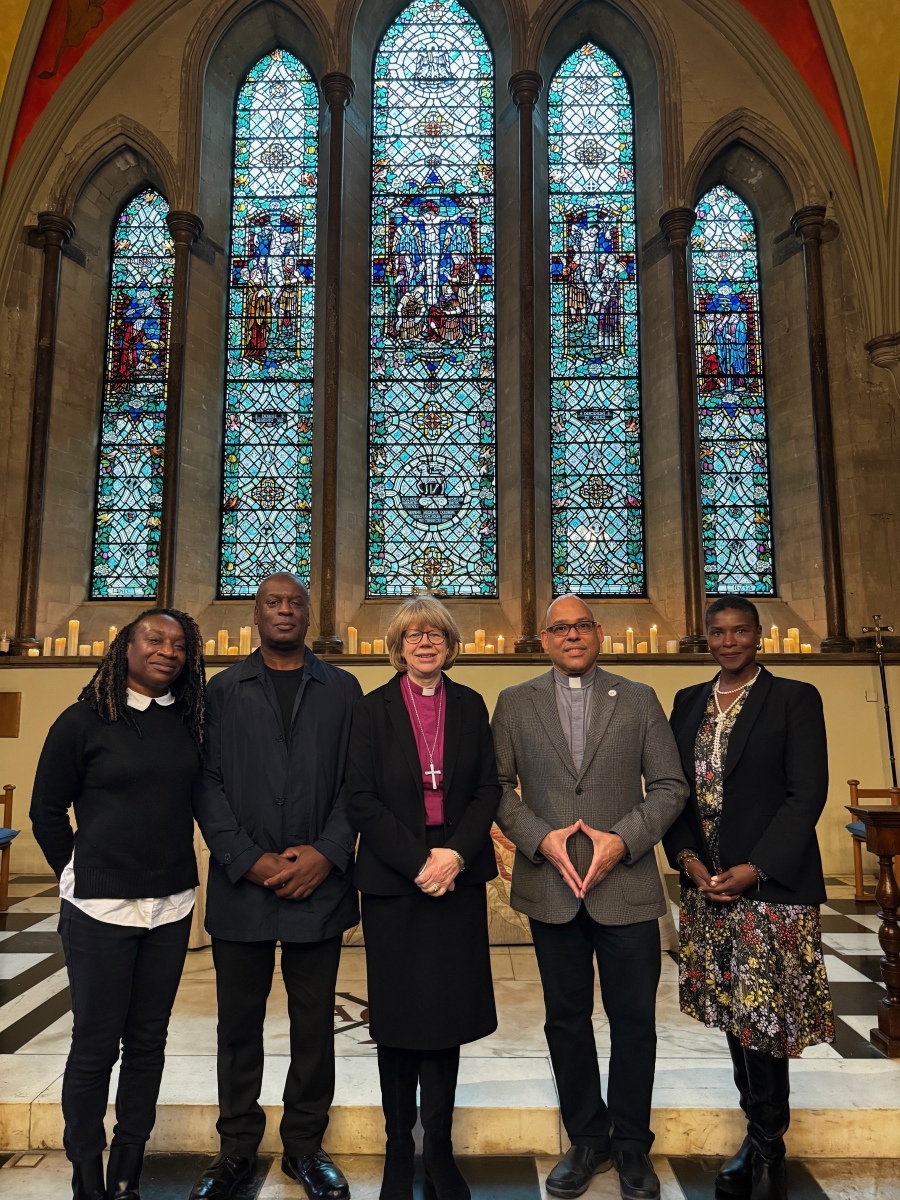
On 8th February, Canon Guy Hewitt, former Barbados High Commissioner to the UK, delivered a sermon for Racial Justice Sunday at Canterbury Cathedral, where he expressed his connection to refugees and asylum seekers. This cathedral serves as the seat of the Archbishop of Canterbury.
Hewitt, the inaugural Director of Racial Justice in the Church of England, shared with the congregation that he knew “what it is like to be displaced and resettled, as in the 1970s, confronted by the National Front, [his] parents – of Caribbean and Indian heritages – chose to leave the UK to raise [his family in Barbados] in racial safety”. That decision was for him, “a life changing experience.”
In a recent interview with the UK Guardian newspaper, Labour peer Alf Dubs, who came to the UK as a refugee and served as an MP and Northern Ireland minister, accused the current Labour government “of using asylum like a ‘political football’ while courting voters backing the Reform [party] or on the right of the Conservative party.”
During his sermon, the Manchester Cathedral Canon noted that “George Floyd’s murder was to be a mountaintop moment towards a Promised Land where people would no longer be judged, to quote Martin Luther King Jr., ‘by the colour of their skin, but by the content of their character’”.
Quoting ML King, the Church’s racial justice Lead emphasised that it remains a ‘dream.’ Hewitt stated that five years after Floyd’s killing, “extremism is becoming normalised and institutionalised.” Without directly referring to Tommy Robinson or Unite, he cautioned “against those who seek to co-opt the Gospel and Christian imagery to sow seeds of division, fear, and intolerance.”
Hewitt, in his diplomatic role, had engaged the UK government over the Windrush scandal. The scandal was the adverse consequences of Theresa May’s ‘Hostile Environment’ policy on elderly, long-term migrants from the Caribbean to Britain during the post-WWII era.
The cleric, at the Mother Church of the worldwide Anglican Communion, founded by St Augustine in 597 AD, emphasised the ‘challenging times facing the world’. The statement by United Nations Secretary-General António Guterres in the 2025 World Social Report was shared with the congregation. Guterres noted that “inequality, insecurity and deep distrust are rife across the world. Countless people are struggling to make ends meet while wealth and power are concentrated at the top.”
The world’s chief diplomat further noted that “Economic shocks, conflict, and climate disasters continue to erase hard-won development gains. For too many, life is marked by uncertainty and insecurity, which, in turn, are fuelling frustration and deepening divisions.”
Addressing to the question of why ‘good people’ may engage in wrongful acts, the priest and former diplomat suggested that it was out of an insecure need “by some people to feel that they are better than others,” who view the world through the “very distorted lenses of ‘different’, ‘other’, and ‘us and them’”.
Hewitt noted that throughout history, different groups of persons were “reduced to an undifferentiated mass of nameless, faceless scapegoats; no longer seen as humans deserving empathy but as objects of disdain and ridicule, over whom structural power and social control can be exerted.” Those mentioned in the powerfully delivered sermon as being ‘dehumanised’ included enslaved Africans, Dalits, Holocaust Jews, dispossessed Irish Catholics, and, more contemporarily Gypsy, Roma and Traveller peoples, Native and Indigenous peoples, and refugees and asylum seekers.
Speaking to the theme of the Good Samaritan, Hewitt asserted that “differences amongst us are not a la carte options where we can choose those characteristics that we are comfortable with and reject others. He reiterated that God calls and challenges us to love each other unconditionally and, through celebrating each other’s uniqueness, to find unity in Him.
He concluded by referencing Martin Luther King Jr’s belief in the power of divine love to overcome hate and emphasised the need to remain ‘people of hope,’ able to see “glimpses of light amid the darkness, and even when we see no light at all, to trust that the light exists.”
On Friday last, Hewitt also delivered the homily at the Lambeth Palace service led by the new Archbishop to mark Race Equality Week. After the service, Hewitt, who trained with her at St Augustine’s College of Theology, joked that while the Holy Spirit touched ‘Sarah, who was in the year above and Rosemarie [Bishop of Croydon, co-Lead Bishop on Racial Justice] in the year below, my class seems to have been bypassed.’.’
