


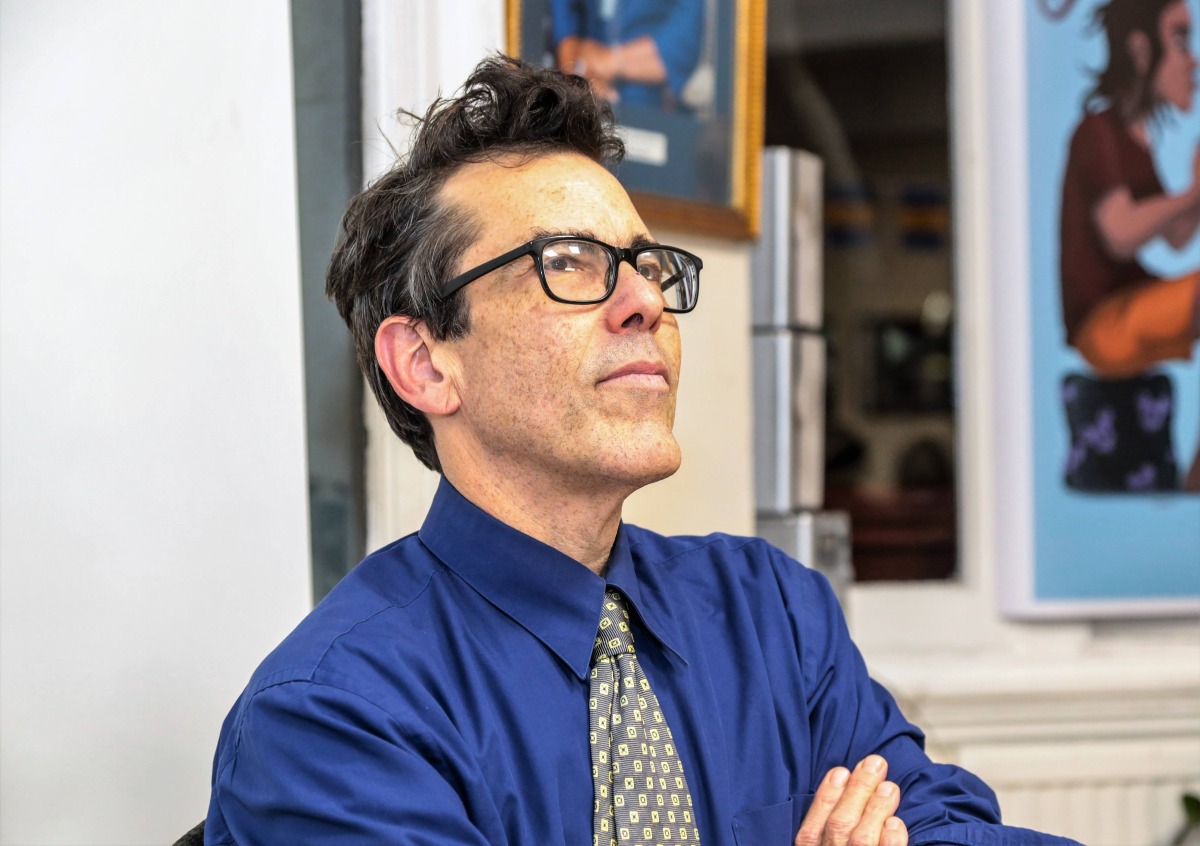
By Prof Richard Drayton
Barbados is small, 430 square kilometres. Already by the 1650s and 1660s, it was one of the most densely populated places in the Atlantic region. Today in the Americas, only Bermuda and St. Martin have a higher population-to-land ratio. Over hundreds of years, it has been a net exporter of people. As we say, wherever you go in the world, you are sure to find a Bajan.
The movement began early. As land became expensive and ownership concentrated, the English conquistadors quickly sought new places to exploit after the first shock of soil deterioration. The Codringtons went to Antigua and the Leewards, the Draxes to Jamaica after its conquest in 1655, the Colletons (and indeed the Draytons) to South Carolina. With them, they took enslaved Africans. To this day, the Afro-Scots-West Country accent of Barbados can be discerned in the speech of people in the Carolinas and the Georgia sea islands. Later Barbadian planter migrations went to the then Dutch colonies of Essequibo, Demerara and Berbice in the 1740s. The last burst came with some who packed up their whiteness and other property and migrated to Australia in the era of political independence in the 1960s.
The poor whites, and never forget that Barbados had and has a small but significant group of the descendants of English, Scots and Irish indentured servants, convicts, paupers and political prisoners, had their own motives to migrate. They took opportunities where they could.
Enslaved Africans and their descendants, of course, had the strongest motivation to escape. But the tiny island, which was so intensively cultivated, offered, unlike vast Jamaica, or the mountains or jungle of Dominica, few options for maronage. Some maroons hid in the gullies and caves. Many more slipped away to the city, seeking to hide in plain sight by working for the British Army at the Garrison or aspiring to be pressed as seamen. Some of them stole boats and travelled west to the mountain fastness of St Vincent, where they mixed into the surviving indigenous people to become what was called the “Black Caribs”.
After the end of Slavery, many Barbadians sought to escape the grinding poverty of the plantation by moving to places where labour was more valued and land was cheaper. British Guiana was the most important outflow. Few Afro-Guyanese cannot claim one or more Barbadian ancestors. – Thus, the Sobers you will find in Essequibo, or the Jacksons, Reids, Draytons and Williams in Georgetown. Some went to Brazil and Peru to work with rubber and railway works — thus, Sir Roger Casement’s first humanitarian mission. A vestige of this remains in a Barbadian folk song, which is parsed as “That cocoa tea/ is a poison to me/every time I drinks it/ I don’t know where I will be”. But which surely began as a song about coca tea.
The impact of these migrants on modern Barbados cannot be underestimated. Then, as the American Empire expanded to build the Panama Canal, the United Fruit Company planted bananas in Costa Rica and Nicaragua, and Cuba’s sugar production exploded. Barbadians fled the poverty and constraints of their island. The money they earned allowed them to buy land, build houses and even, in some cases, to be rich enough to vote.
In the 1980s, with David Browne and Henderson Carter, I drove around Barbados. seeking out the traces of these Garveyites in South District in St George, in St John, in Indian Ground in St Peter, in Six Men’s Bay in St Lucy. You heard stories of men like the panboiler, who returned from Cuba in 1925 a fervent Garveyite, then joined O’Neale’s Democratic League, the Barbados Workers’ Union, and was a stalwart of the Barbados Labour Party. That party had its first impetus from Barbadian migrants in New York. But they also brought new political ideas: Barbadians who returned from Panama and Cuba really entrenched Marcus Garvey’s UNIA in Barbados. Eric Duke has, of course, shown how the Caribbean migrants in the United States shaped the politics of the nation and federation from the outside.
Migration was a means, after Slavery as during it, of escaping the power of the plantocracy. The Barbadian planter George Carrington, in his testimony to the West India Royal Commission of 1897, declared:
“The Barbadian Negroes are most civil as a rule, especially in daylight, to the managers and to us, but you will see the same nigger goes down to Demerara he will stand and look at the manager and whistle in his face, and cheek him in any kind of way.”
It is that in Barbados we have such an ample command of the labour, there is such a lot of them that they must work and behave themselves”
That “ample command of the labour” relates to the planters’ capacity to drive down wages. Its impact was to export Barbados’s troublemakers, culminating in a field of significant political leaders, including Hubert Critchlow and A. A. Thorne. They founded the trade unions in British Guiana. Clement Payne and George Padmore in Trinidad, Richard Moore in the United States, and a range of now-forgotten figures in Panama and Cuba.
The colonial relationship meant that surpluses were primarily accumulated in Britain. There was little support for artists, writers, intellectuals, or scientists. So, for decades, in the phenomenon described with such precision in George Lamming’s *Pleasures of Exile*, people migrated for education and opportunities to pursue their work and gifts. As Lamming wrote later, ‘such are the contradictions of this imperial arrangement, that this same power which had organised the castration of our creative energies, would be responsible for returning our names where they belonged. The enemy had rescued us from total anonymity. Barbadians have quietly played critical roles in science, medicine, the humanities, and letters worldwide, providing Britain with an Astronomer Royal, Yale with a Professor of Psychiatry, Canada with its leading plastic surgeon, and so on.
Over the 55 years since political independence, there have been repeated noises about “the diaspora” and its potential contributions to national life. Efforts have been made here and there, returning nationals received various tax benefits, plans were made for consultations. Some diplomats overseas, one thinks of Guy Hewitt’s immense contribution in Britain, have created moments of high engagement. But no government has really worked hard at finding ways to include overseas citizens in national life.
One aspect of underdevelopment is the underexploitation of your own resources. What characterises the emigrants from the rock, however tightly they become embedded, is that they always cast an eye home with a certain wistfulness and affection. Its members and their children, and children’s children, long after they have left Barbados, keep its memory alive, and cultivate that care for neighbour and community, which allowed earlier generations to survive conditions of brutal poverty. In Britain, I have had the privilege over the years to work closely with the National Council of Barbadian Associations and its Chairman, Tyrone Roach. Sharing fish cakes, conkies, peas and rice, sorrel and rum, they recreate the island in their midst, offering our version of ‘next year in Jerusalem’.
